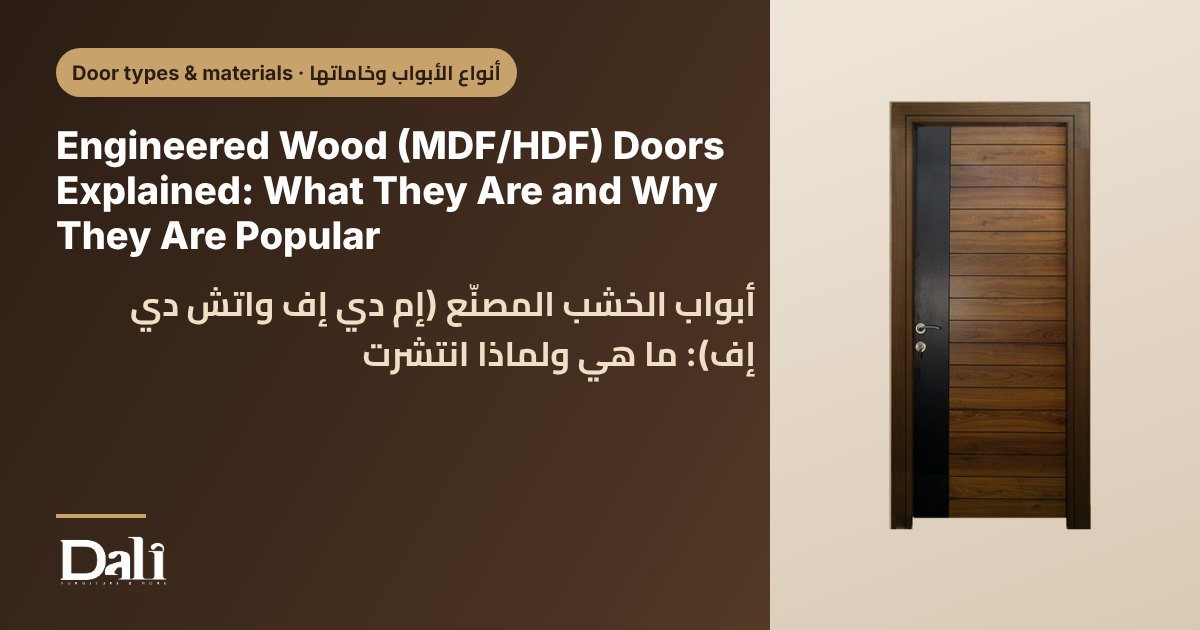
Engineered Wood (MDF/HDF) Doors Explained: What They Are and Why They Are Popular
If you have shopped for interior doors in recent years, you have almost certainly met the letters MDF and HDF. These engineered boards sit inside or underneath a large share of modern doors. Understanding what they are, and what they are not, helps you judge a door by its real quality instead of its label.
What are MDF and HDF?
MDF stands for medium-density fiberboard and HDF for high-density fiberboard. Both are made by breaking wood into fine fibers, mixing them with a binder and pressing them under heat and pressure into flat, uniform boards. HDF is pressed to a higher density than MDF, which usually makes it harder and stronger on the surface, although the exact density and quality differ between manufacturers.
How they are used in doors
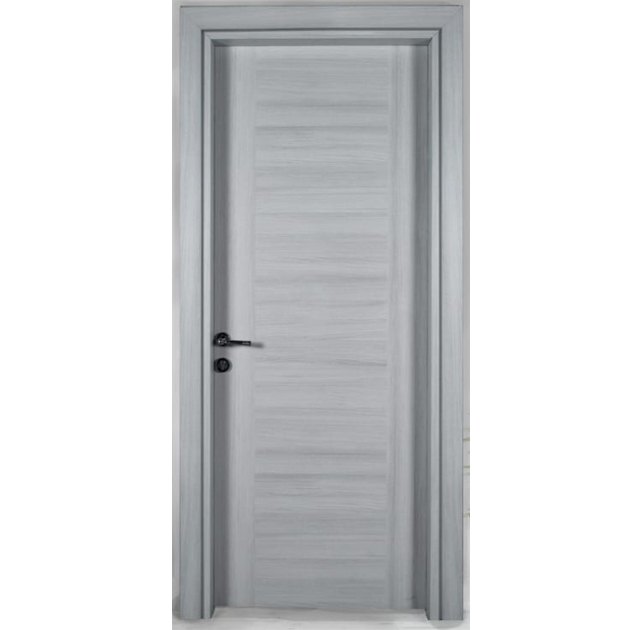
Engineered boards appear in doors in a few typical ways. In some doors the board forms the whole leaf, with the surface applied directly on top. In others, thin HDF skins are glued over an internal frame or filled structure, giving a lighter leaf. Moulded HDF skins can also carry shapes that imitate panels. Whatever the build, the visible surface is then finished with paint, melamine, PVC film, HPL or veneer, and this surface layer decides much of the door's everyday behavior.
It helps to remember that the board is only one part of the door: the surface, the edge sealing and the way the leaf is assembled all affect how long it lasts.
Strengths
- Uniform and flat: there are no knots or grain defects, so surfaces come out smooth and consistent.
- Stable shape: a well-made board is less likely to crack along the grain than a plank, though it can still react to moisture.
- Finish friendly: it takes paint, films and laminates very well, which opens a wide range of colors and styles.
- Value: engineered doors are usually more affordable than solid timber of similar size.
Limits you should know
The main weakness of fiberboard is water. If moisture reaches an unprotected edge or a damaged surface, the board can swell and lose its shape, and this cannot easily be reversed. For this reason the quality of edge sealing and the surface layer is just as important as the board itself. Fiberboard also holds screws less strongly than solid wood, so hinge and lock positions should be reinforced or installed carefully, and repeated removal and reinstallation of screws in the same holes is best avoided.
| Point | MDF | HDF |
|---|---|---|
| Density | Medium | Higher |
| Surface hardness | Good for most interior uses | Usually harder and smoother |
| Moisture | Needs sealed surface and edges | Also needs sealed surface and edges |
| Common finishes | Paint, melamine, PVC film, veneer | Paint, melamine, PVC film, HPL, veneer |
For most dry rooms in the home, a well-made engineered door does its job reliably for many years when it is installed correctly and cleaned sensibly, which is why designers and contractors use it so widely in apartment projects.
How to choose what suits your home
- Room: engineered boards suit bedrooms, offices and hallways well; for bathrooms and kitchens, insist on a fully sealed, moisture-resistant surface.
- Climate: in humid or coastal places, check that all edges, including the bottom edge, are covered and sealed.
- Budget: a good engineered door with a strong surface often gives better value than a low-quality solid wood door.
- Family: for homes with children, choose a surface that resists scratches and can be wiped without damage.
- Style: because the surface can be painted or laminated, you can match any color scheme or wood-look pattern.
- Maintenance: wipe spills quickly, avoid soaking the lower part of the door when washing floors, and repair chips early.
See the range at the Dali shop to find engineered doors in PVC, melamine, HPL and painted finishes for each room.