Swing Direction: Left or Right Hand, Inward or Outward
Swing direction is a small detail that has a big effect on daily comfort. A door that opens the wrong way can hit a wardrobe, hide a light switch or block the corridor. It is also one of the easiest things to get wrong when ordering, because people describe it in different ways. A clear method removes the confusion.
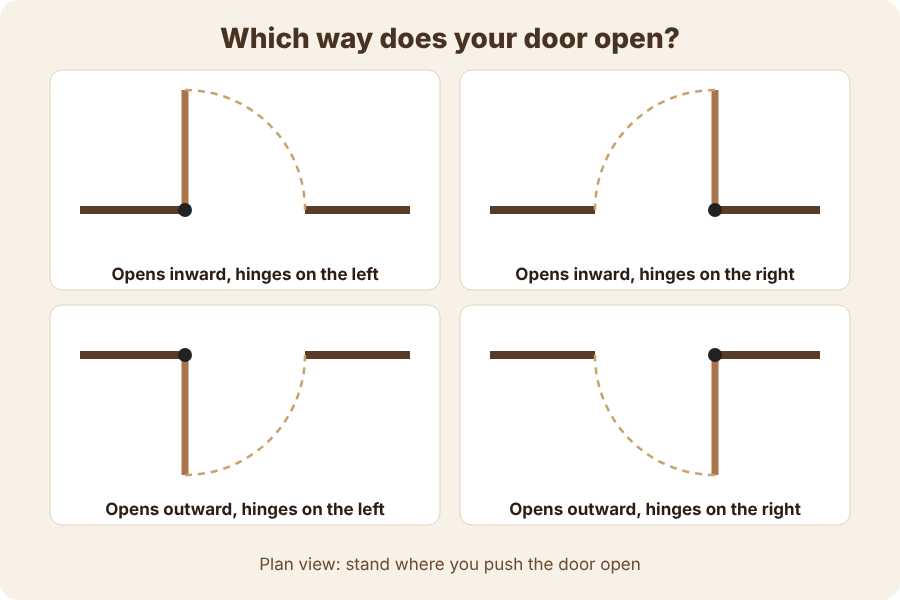
The two questions to answer
Every swing can be described by two choices. First, where are the hinges: on the left or the right side of the opening? Second, does the door open toward you or away from you? Together they give four combinations, and each one suits different situations.
How to find the hand of a door
Stand on the side from which the door opens toward you, as if you are about to pull it open. If the hinges are on your left, it is commonly described as a left-hand door; if they are on your right, a right-hand door. Different suppliers and countries use different naming systems, so do not rely on the word alone. The safest method is to send a simple sketch or a photo with arrows, and to write clearly which side the hinges and the handle should be on, as seen from the side where the door opens toward you.
Inward or outward
For bedrooms and offices, doors usually open into the room, which keeps the corridor clear and gives privacy. For small bathrooms, an outward opening can save floor space, but it must not block a busy corridor. In general, avoid opening doors toward each other where two doors face one another, since they may collide.
| Situation | Often better choice |
|---|---|
| Bedroom with free wall space | Opens inward, hinged near the wall |
| Small bathroom | May open outward to save space, if the corridor is wide enough |
| Narrow corridor with several doors | Check collisions; avoid doors that face each other |
| Room with a light switch near the door | Hinge on the side away from the switch |
Practical tips for choosing
- Open the door in your mind, or tape its swing arc on the floor, to see what it hits.
- Prefer to open the door against a blank wall rather than into the middle of a room.
- The door should reveal the room gradually rather than expose a bed or a bathroom to the corridor.
- Keep light switches on the latch side, where your hand naturally reaches as you enter.
- Consider ease of use if someone with limited mobility enters the room.
Safety and emergencies
In rooms where someone might become unwell, such as a bathroom, think about whether the door could be blocked from the inside. An outward-opening door or a lock that can be released from outside gives extra reassurance for families with elderly members or small children.
Double-check before you order
Once you decide, write the swing in plain words, for example: hinges on the right, opens into the bedroom. Add a small drawing for each door and keep the same description in your notes and your order. This simple habit prevents most mistakes.
How to choose what suits your home
- Room: decide the swing separately for each room, based on furniture position and traffic.
- Climate and humidity: for a steamy bathroom, make sure the swing leaves room for air to circulate and does not press the door against damp walls.
- Budget: changing the swing after the frame is installed is costly, so fix the direction in your plan before ordering.
- Family: keep children's rooms and bathrooms easy to open from outside in an emergency.
- Style: where two rooms share a view, line up the hinges so the doors look tidy when open.
- Maintenance: avoid a swing that makes the handle hit the wall, as repeated knocks mark paint and finishes.
Browse the Dali shop to find the right door, then tell us the swing direction you need.