Standard Door Sizes and Custom Sizes: What to Know Before Ordering
When you start shopping for doors you quickly meet two words: standard and custom. A standard size is a common, widely used dimension; a custom size is made to fit an unusual opening. Understanding both helps you avoid delays, extra cost and doors that look out of proportion.
What counts as a standard size?
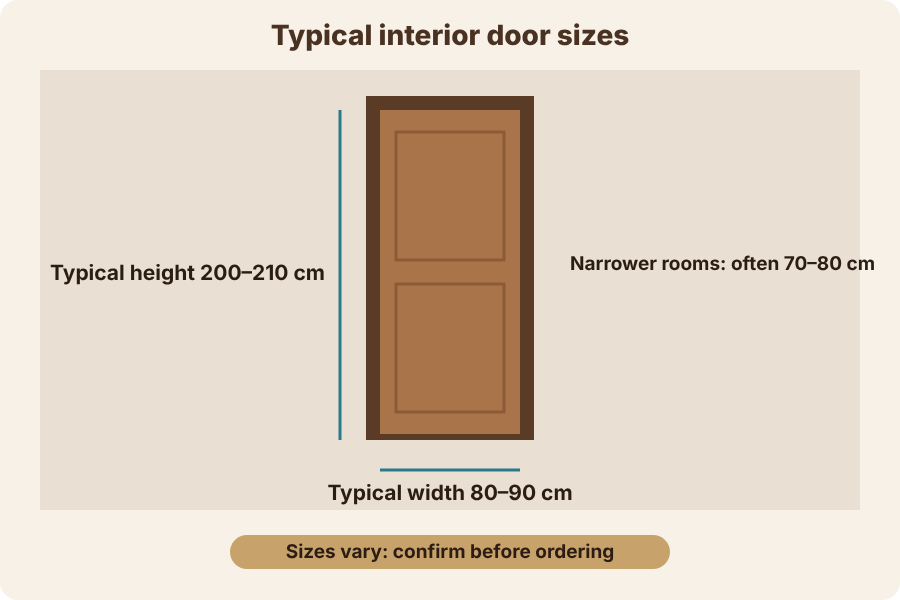
There is no single rule that every home follows, but many interior door leaves are typically around 80 to 90 cm wide and around 200 to 210 cm high. Bedrooms and living areas often use the wider end of that range, while bathrooms and storage rooms sometimes use narrower leaves, around 70 to 80 cm. Treat these as typical figures, not requirements: your building and your supplier's range come first.
Leaf size versus opening size
This is the most common confusion. The leaf is the moving panel. The opening is the clear space in the wall once the frame is installed. The frame and the working gaps take up some of the opening, so the leaf is always a little smaller than the hole in the wall. Always ask whether a quoted size refers to the leaf, the frame or the finished opening.
| Term | What it means |
|---|---|
| Leaf size | Width and height of the door panel itself |
| Frame size | Outer dimensions of the frame (khalon) |
| Wall opening | The rough hole in the wall before the frame |
| Clear opening | The space you walk through when the door is open |
When standard sizes work best
Standard sizes are usually the simplest choice in new apartments where openings were built to common dimensions. They can be easier to source, easier to replace later and often more economical because they match the production range. If your openings are close to a common size, it is often practical to adjust the opening slightly rather than make everything custom.
When a custom size makes sense
- Older buildings with unusual openings.
- Very tall or very wide doorways.
- Rooms where accessibility requires a wider clear opening.
- Designs that need a leaf to match a particular wall layout.
Custom sizes give a precise fit, but they require exact measurements and clear communication. Check with the supplier what size range can be made, because very large leaves may need stronger construction and hardware.
How size affects the door itself
Wider and taller leaves are heavier and put more load on the hinges. They may need more than two hinges and a stronger frame. Thinner or lighter doors in an oversized opening can feel flimsy, so discuss weight and hardware whenever you move away from typical sizes.
Questions to ask before ordering
- Is the quoted size for the leaf, the frame or the opening?
- What gap should be left around the leaf for smooth movement?
- Does the frame depth match my wall thickness?
- If I choose a custom size, can the same style be repeated for other rooms?
How to choose what suits your home
- Room: use a comfortable width for main rooms and narrower leaves only where space is tight, such as a small bathroom.
- Climate and humidity: larger wood-based leaves can move slightly with humidity, so ask about the right finish and edge protection.
- Budget: standard sizes are usually the most economical, so keep custom sizes for openings that truly need them.
- Family: think about moving furniture and prams; a slightly wider door makes daily life easier.
- Style: keep leaf heights consistent across the home so the doors line up visually.
- Maintenance: heavy leaves put more strain on hinges, so plan for good hardware and occasional adjustment.
Browse the Dali shop to explore our doors and find the size that fits your home.