Soundproof Doors: How to Reduce Noise Between Rooms
Whether it is a home office next to the living room, a child's bedroom near the kitchen, or a teenager's music, noise travels easily through interior doors. No ordinary door makes a room truly silent, but the right choices can reduce noise noticeably. The key is to understand how sound actually gets through.
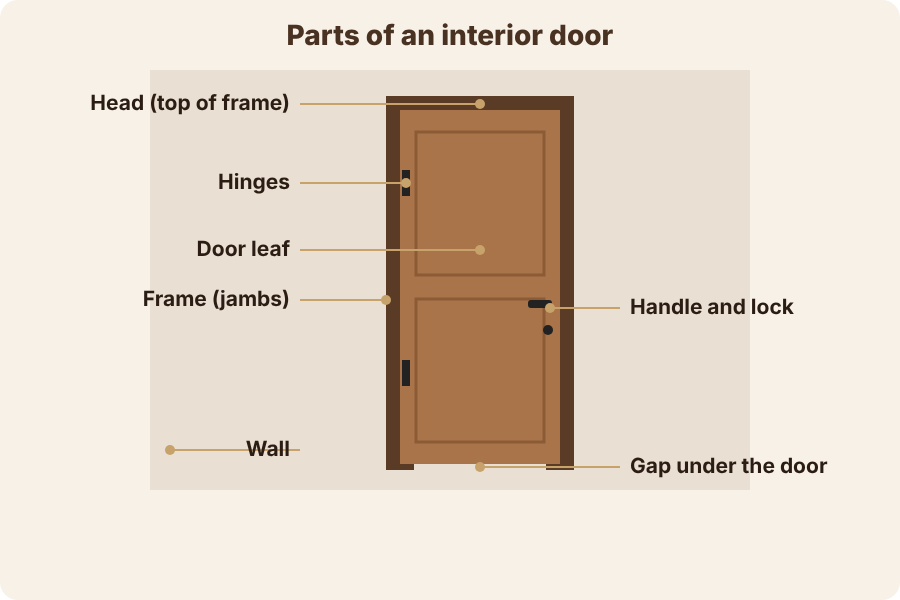
How sound passes through a door
Sound moves in two main ways: through the material of the door itself, and through gaps around it. A light hollow door vibrates easily, so it lets more sound pass. But even a heavy door performs poorly if there is a wide gap at the bottom or sides, because sound slips through openings very efficiently.
- Mass: heavier, denser leaves usually block more sound than light ones.
- Construction: a solid or dense core generally performs better than a hollow honeycomb or cardboard core.
- Gaps: clearances at the bottom and around the frame are often the biggest weakness.
- Frame and wall: flanking paths through the wall opening and frame can carry sound around the door.
Choosing the leaf
For better sound reduction, look for a door with a solid or dense core and a reasonable thickness rather than a very light hollow leaf. Surface finish such as PVC, melamine, HPL or paint matters much less for sound than the core does; the finish is chosen for look and durability. Ask the seller to describe the core in plain terms, and feel the weight of the leaf when comparing options.
Sealing the gaps
Sealing is the cheapest and most effective upgrade, and it works on many existing doors.
- Perimeter seals: adhesive or rebated seals in the frame close the small gaps along the top and sides when the door shuts.
- Bottom seal: a sweep fixed to the bottom edge, or an automatic drop-down seal, closes the gap above the floor.
- Latch tightness: make sure the door closes firmly against the seals, adjusting the strike plate if needed.
- Frame to wall: check that the space between the frame and the wall is filled properly, with no visible cracks.
Note that a tight seal also reduces air flow. In bathrooms and rooms with heating or cooling, plan for ventilation elsewhere.
What to expect
| Upgrade | Typical effect | Notes |
|---|---|---|
| Dense or solid core leaf | Noticeable improvement | Heavier door, stronger hinges needed |
| Perimeter seals | Reduces leakage at sides and top | Inexpensive, easy to fit |
| Bottom sweep or drop seal | Reduces the largest gap | Can drag on thick carpet |
| Sealed frame and wall joint | Reduces flanking noise | Best done at installation |
Even with all of these, deep bass and loud voices will still be partly audible. If you need near-silence, such as a recording room, you will need specialist construction beyond a regular interior door.
How to choose what suits your home
- Room: prioritise bedrooms, home offices and nurseries; a hallway cupboard rarely needs it.
- Climate and humidity: in bathrooms, use water-resistant materials and keep some ventilation, even with sealing.
- Budget: start with seals and a bottom sweep; upgrade to a solid core leaf where the noise problem is serious.
- Family: with young children or night-shift workers, a heavier door and soft-close hardware help avoid slamming.
- Style: choose the finish to match the home; sound performance comes from the core and the fit.
- Maintenance: check seals and hinges once a year, since worn seals lose their effect.
Explore the Dali shop to compare door finishes and find a door that fits your quiet rooms.